Designing a strong roof starts with one critical reference: the rafter span chart. Whether you’re planning a new build or checking an existing structure, understanding how far rafters can safely span helps prevent sagging, cracking, and long-term structural issues. This guide breaks everything down in simple terms so you can use span charts correctly and confidently.
What Is a Rafter Span Chart and Why Does It Matters
A rafter span chart is a reference table that shows the maximum allowable horizontal distance a rafter can span without additional support. These limits are based on engineering standards and building codes.
Using the correct roof rafter span table matters because undersized rafters can lead to roof deflection, drywall cracks, and even structural failure. Proper rafter sizing ensures your roof handles its own weight, roofing materials, and environmental loads like snow or wind.
Importance of Proper Rafter Sizing for Structural Integrity
Rafters work as load-bearing members. If the span exceeds what the lumber can handle, the roof will slowly bend under stress. Over time, this affects not just the roof but also the walls and foundations. A correctly sized rafter system improves safety, longevity, and code compliance.
Understanding Rafter Span Basics
How Rafter Spans Are Measured
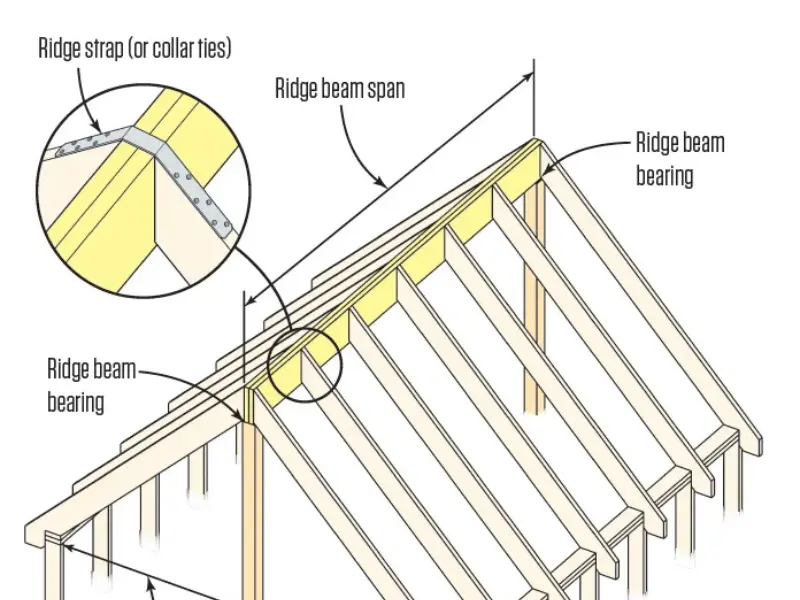
Rafter spans are measured by horizontal projection, not the diagonal length of the rafter. This means you measure from the outside edge of one supporting wall to the other, straight across.
Key Factors That Affect Rafter Spans
Several variables determine how far a rafter can span safely:
-
Lumber species (Douglas Fir, Southern Pine, SPF)
-
Grade (No.1, No.2, Select Structural)
-
On-center spacing (12″, 16″, or 24″)
-
Live loads (snow, maintenance)
-
Dead loads (roofing materials, sheathing)
A 2×6 rafter span chart will show much shorter spans than a 2×10 Roof rafter span table because depth directly affects strength.
Reading a Rafter Span Guide: Step-by-Step
1. Identify Lumber Species and Grade
Start by finding the correct column for your lumber type and grade. Southern Pine usually allows longer spans than Spruce-Pine-Fir at the same size.
2. Understand On-Center Spacing
Most charts list spans for rafters spaced at 12″, 16″, or 24″ on center. Wider spacing reduces the allowable span.
3. Check Live Load vs. Dead Load
Live loads include snow and temporary weight. Dead loads include shingles, underlayment, and framing. Snow-prone regions typically require higher live-load values.
4. Deflection Limits Explained
You’ll see ratios like L/180 or L/240. These control how much a rafter is allowed to bend. Lower deflection means a stiffer, more solid roof.
Complete Rafter span guide Tables (Overview)
While full tables are extensive, span charts are usually grouped by load conditions:
20 psf Live Load (Low Snow Areas)
Common in warm climates. Smaller rafters may work for short spans.
30 psf Snow Load
A common standard in many regions. Often requires stepping up from a 2×6 rafter span chart to a 2×8 Rafter sizing chart
50 psf Snow Load
Used in heavy-snow areas. Larger rafters like those shown in a 2×10 rafter span chart are often necessary.
Common Lumber Species
Most charts include:
-
Douglas Fir–Larch
-
Southern Pine
-
Spruce-Pine-Fir
Always match the chart exactly to your lumber stamp.
How to Use a Roof Framing Load Span Chart for Your Project
Real-World Example
If your building width is 24 feet, the horizontal rafter span is roughly 12 feet. With 16″ spacing and a 30 psf snow load, a 2×8 rafter span chart may show that a 2×8 is acceptable, while a 2×6 is not.

Determine Local Snow Load
Snow load varies by location. Local building departments or code offices provide required values. Never assume, always verify.
Choose the Right Rafter Size
Match your span, spacing, species, and load conditions. When in doubt, going up one size adds a safety margin.
Common Mistakes to Avoid
-
Measuring the diagonal rafter length instead of the horizontal span
-
Ignoring local building code requirements
-
Assuming spacing without checking the chart
-
Using the wrong lumber species or grade
These mistakes are a common cause of failed inspections and roof problems.
Final Thoughts and Building Code Resources
A rafter span chart is one of the most important tools in roof framing. It protects your structure, helps inspections go smoothly, and reduces the risk of costly repairs later. Always cross-check your design with your local building department and the International Residential Code (IRC) or the equivalent code used in your area.
When in doubt, consult a licensed builder or structural professional. A few extra minutes reviewing span limits can prevent years of structural trouble. If you’d like expert guidance or a second opinion on your roof framing plans, contact us today. We’re happy to help you make the right, code-compliant decision with confidence.
Join Our Community
Join our community on Facebook, and don’t forget to subscribe to us on YouTube for new content each week.
FAQs
What is a Rafter sizing chart used for?
It shows the maximum safe distance a rafter can span based on size, spacing, species, and load.
Is a roof rafter span chart the same for all climates?
No. Snow and wind loads change the allowable spans.
Can I use a 2×6 rafter for long spans?
Only for short distances and low loads. Longer spans usually require larger lumber.
Do I need engineering approval if I follow the chart?
If you follow code-approved charts and local requirements, engineering is usually not required for standard residential roofs.
Where do span charts come from?
They’re based on structural engineering data and adopted by building codes.